
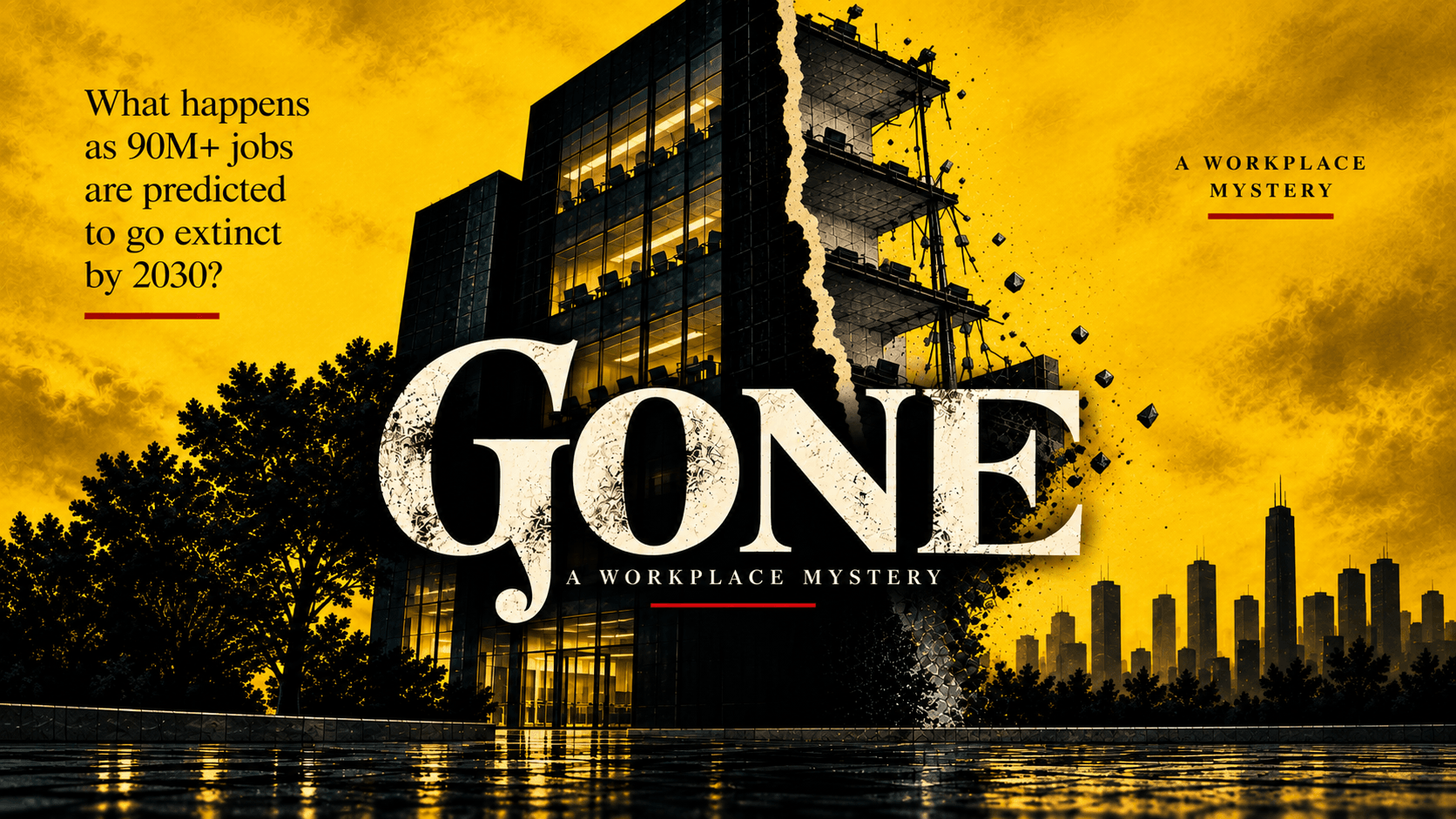
GONE: A Workplace Mystery
From the desk of an Insider (Still here...)
PART I
THE SCARIEST PART IS HOW NORMAL EVERYTHING LOOKED.
People were still going to work. People who went to work, anyway. Half the company seemed to live inside little squares on Teams by then. Cameras off. Green dot on. Maybe working. Maybe folding laundry. Nobody asked too many questions as long as the work got done.
Checks were clearing. People were getting promoted. Quarterly meetings still had entirely too many slides. Somebody was still replying-all to emails that absolutely did not require all.
You know.
Work.
Meanwhile, the ground underneath millions of jobs was starting to move.
Quietly at first.
AI. Automation. Restructuring. New competitors. New business models. Companies figuring out they could do more with fewer people. Jobs disappearing in one place while entirely new ones appeared somewhere else.
Everybody knew something was changing.
We just weren’t particularly convinced it was changing us.
After all, the company was doing well. You were good at your job. Your manager liked you. Your last performance review went great. They’d just promoted you. They couldn’t possibly run that department without you.
Right?
That’s where this gets uncomfortable.
Because what happens when the company is doing well...and your job still disappears?
What happens when you’re excellent at work the company no longer needs done the same way? When you finally get the promotion you’ve been chasing just as the value of that promotion begins to change?
What happens when your industry doesn’t collapse at all—
it just stops needing as many people like you?
Well.
Turns out the thing that should’ve kept us up at night wasn’t hiding under the bed. It was already on the payroll.
And before you start looking for the villain, don’t bother.
That’s what made this so hard to see.
There was no single threat. No one terrible CEO. No one technology. No disastrous quarter. No meeting where somebody stood up and announced, Just a heads-up, everybody. The rules underneath your economic security are about to change.
Nothing that convenient.
It was more like a butterfly effect. One small change disturbed something else. Then that changed something else. Then somebody responded to that.
A team got smaller. Three open positions quietly stopped being open. Software started doing in minutes what somebody used to spend half a day doing. A department reorganized, then another followed. Somebody important left. Somebody else got promoted.
None of it looked connected.
Turns out, almost all of it was.
And while all of that was happening, people kept doing what people do. Working. Planning. Buying houses. Having babies. Waiting for bonuses. Putting another 6% into the 401(k). Telling themselves they’d update LinkedIn eventually. Promising this was the year they’d finally build relationships outside the company. Waiting until things “settled down” to learn whatever new thing everybody kept saying they should learn.
Normal life.
That’s the part that gets me.
Because if something terrible looks terrible, most reasonably intelligent people know to move.
This didn’t.
Not at first.
Which is probably why I’m telling you any of this.
And technically, I’m probably already telling you more than I should.
So before I change my mind, there’s a company you need to know about.
Revivus Industries.
Rev, if you worked there.
Founded in 1986. Profitable. Respected. Stable. The kind of place where people didn’t just work.
They stayed.
Recessions came and went. Markets crashed. Competitors showed up. COVID sent everybody home, and somehow Rev came out the other side.
There was an almost obnoxious confidence about the place.
If the industry ever went to hell, somebody would joke, Rev would be one of the last ones standing.
And everybody would laugh.
Because obviously.
We even had a motto:
“WE TAKE CARE OF OUR PEOPLE.”
And for a long time?
They did.
As long as they could.
Then came 2026.
Forty years of Rev. New CEO. New technology. New pressures.
Same people. Same jobs. Same assumptions.
At least that’s what it looked like.
Here’s the problem.
You can’t understand what happened to Rev without understanding the people who were there when it happened.
And these six?
They all walked into 2026 thinking about their futures very differently.
There are a lot of people I could introduce you to. Most of them don’t matter yet.
These six do.

- Rick MercerPresident & CEO
- Kate WhitmoreChief Human Resources Officer
- Marcus ReedSenior Operations Manager
- Dr. Nia BennettStrategy & Program Leader
- David AlvarezVP, Supply Chain & Operations
- Maya PatelDirector, Business Operations
You’re probably one of them. You just don’t know which one yet.
I pulled their files.
Probably shouldn’t have.
I’ve already said more than I planned to.
Same people. Different future.